
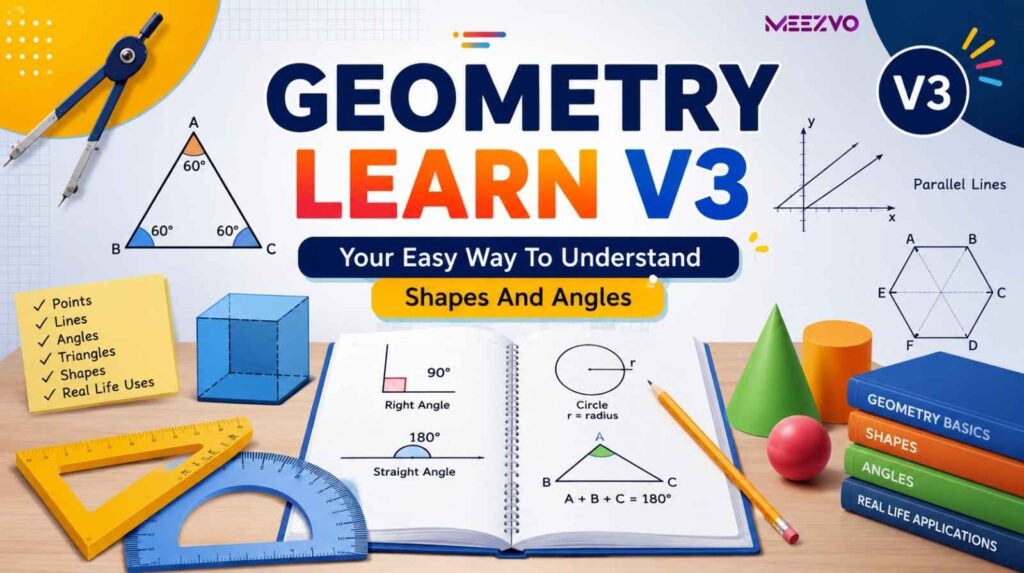
Understanding shapes and angles doesn’t have to feel confusing or overwhelming. In fact, once you see how geometry works in the real world, everything starts to click. That’s exactly what geometry learn v3 is designed to do. It strips away complexity and focuses on clear, visual, and practical learning.
This guide walks you through geometry basics, step by step. You’ll move from simple ideas like points and lines to advanced shape understanding, all while seeing how geometry shows up in everyday life.
Why Geometry Feels Hard (And How Geometry Learning V3 Fixes It)
Most people struggle with geometry for one simple reason: they try to memorize instead of understand.
Think about it. You might remember that a triangle equals 180 degrees. But do you actually know why?
That’s where geometry learning v3 changes the game.
Instead of memorizing formulas, you:
- Visualize shapes
- Connect ideas to real life
- Understand patterns naturally
“Geometry isn’t about numbers. It’s about seeing the world differently.”
What Is Geometry, Really? (Simple and Clear)
Geometry is the study of shapes, sizes, and how objects relate to each other in space. It’s part of math fundamentals, but it’s also everywhere around you.
Core Areas of Geometry
- Plane Geometry – Flat shapes like squares and circles
- Solid Geometry – 3D objects like cubes and spheres
Why Geometry Matters
You use geometry more than you think:
- Architects design buildings using geometric forms
- Artists create balance using symmetry
- Engineers rely on angular measurements
- Even nature follows world geometry patterns
The Building Blocks of Geometry (Start From Zero)
Before jumping into shapes, you need to understand the basics.
Points: The Starting Dot
A point is just a position. It has no size.
Think of:
- A location on a map
- A tiny dot on paper
Simple, right?
Lines and Line Segments
Lines are everywhere.
- Line – Goes on forever
- Line Segment – Has a fixed length
- Ray – Starts at one point and continues
Real-Life Examples
- A ruler edge
- The side of a book (book side)
- Straight roads (straight edges)
Planes: Flat Surfaces
A plane is a flat surface that extends endlessly.
Examples:
- Wall surfaces
- Floors
- Screens
Picture a wall-floor junction. That’s where planes meet.
Angles Made Easy: Understanding Turns and Directions
Angles are one of the most important parts of geometry basics.
What Is an Angle?
An angle forms when two lines meet at a point.
That point is called a vertex.
Angles measure how much something turns.
Types of Angles (With Easy Memory Tricks)
| Angle Type | Degree Range | Simple Example |
|---|---|---|
| Acute | Less than 90° | Pizza tip, leaf point |
| Right | 90° | Square corner, L-shape |
| Obtuse | Over 90° | Arm stretch, open turns |
| Straight | 180° | Flat line, linear turn |
Helpful Memory Tip
- Acute = sharp angles
- Right = perfect corner (90 degrees)
- Obtuse = wide angles
Real-Life Angle Examples
You see angles everywhere:
- Clock hands
- Road turns
- Door openings
- Corners of furniture
Triangles Explained Without Confusion
Triangles are the foundation of educational geometry.
Types of Triangles by Sides
- Equilateral Triangle
- All sides equal
- 60 degree angles
- A balanced triangle
- Isosceles Triangle
- Two equal sides
- Matching angles
- A symmetric triangle
- Scalene Triangle
- All sides different
Types by Angles
- Acute triangle
- Right triangle (90 degree triangle)
- Obtuse triangle
The 180° Rule (Why It Always Works)
Every triangle adds up to 180 degrees.
Think of it like this:
- Lay the angles flat
- They form a straight line
This is called a supplementary pair or linear turn.
Why Triangles Matter
Triangles are strong.
That’s why you see them in:
- Bridges
- Roofs (roof ramp)
- Construction frames
Quadrilaterals and Everyday Shapes
Quadrilaterals have four sides.
These are simple polygons but incredibly important.
Square vs Rectangle (Clear Difference)
| Feature | Square | Rectangle |
|---|---|---|
| Sides | Equal sides | Opposite sides equal |
| Angles | All 90° | All 90° |
| Shape | Perfect symmetry | Longer form |
Other Important Shapes
- Parallelogram
- Opposite sides parallel
- Rhombus
- All sides equal
- Looks like a diamond
- Trapezium
- One pair of parallel sides
These are all part of fundamental forms and starter figures.
Circles and Curved Geometry (No More Confusion)
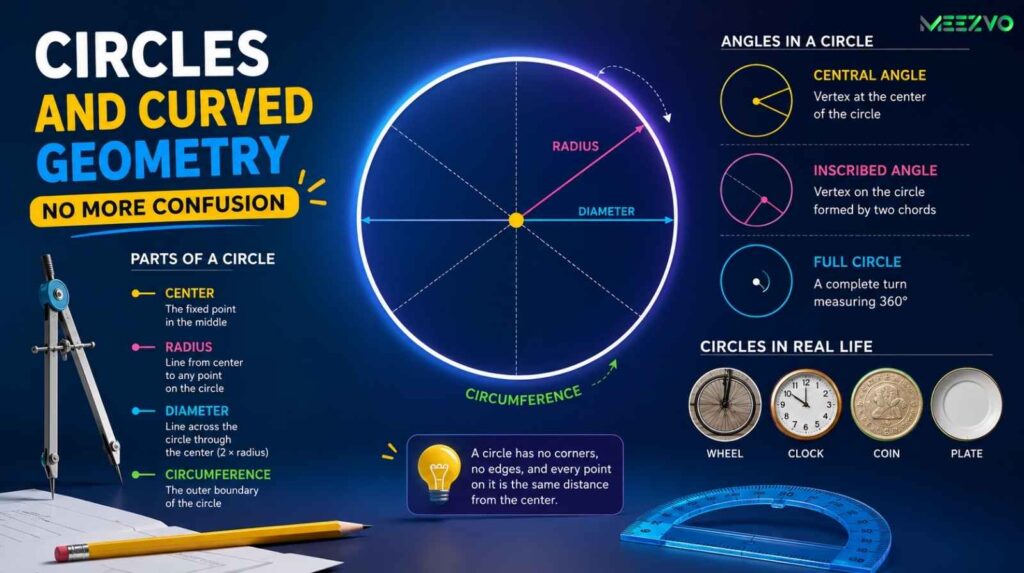
Circles are different because they use curve lines instead of straight ones.
Parts of a Circle
| Part | Meaning |
|---|---|
| Radius | Center to edge |
| Diameter | Across the circle |
| Circumference | Outer boundary |
Do Circles Have Angles?
Yes, but differently.
- Central angles form at the center
- A full circle = 360°
- Half circle = 180 degrees
Real-Life Circle Examples
- Wheels
- Coins
- Plates
- Clocks
3D Shapes: Understanding the Real World
Geometry isn’t just flat.
You live in a 3D world full of spatial figures.
Common 3D Shapes
- Cube
- Sphere
- Cylinder
- Cone
2D vs 3D Quick Comparison
| Feature | 2D Shapes | 3D Shapes |
|---|---|---|
| Dimensions | Length, Width | Length, Width, Height |
| Example | Square | Cube |
Geometry in Real Life (Where It Actually Matters)
Geometry isn’t just theory. It’s everywhere.
Daily Applications of Geometry
- Architecture
- Buildings use precise polygon edges
- Nature
- Snowflakes = hexagons
- Sunflowers = spiral patterns
- Technology
- Graphics and animation
- Sports
- Angles determine movement
Real-Life Examples Table
| Area | Geometry Use |
|---|---|
| Construction | Strong triangular designs |
| Art | Symmetry and balance |
| Maps | Navigation angles |
| Design | Proportions and shapes |
Geometry Learn V3 Method: Step-by-Step Learning System
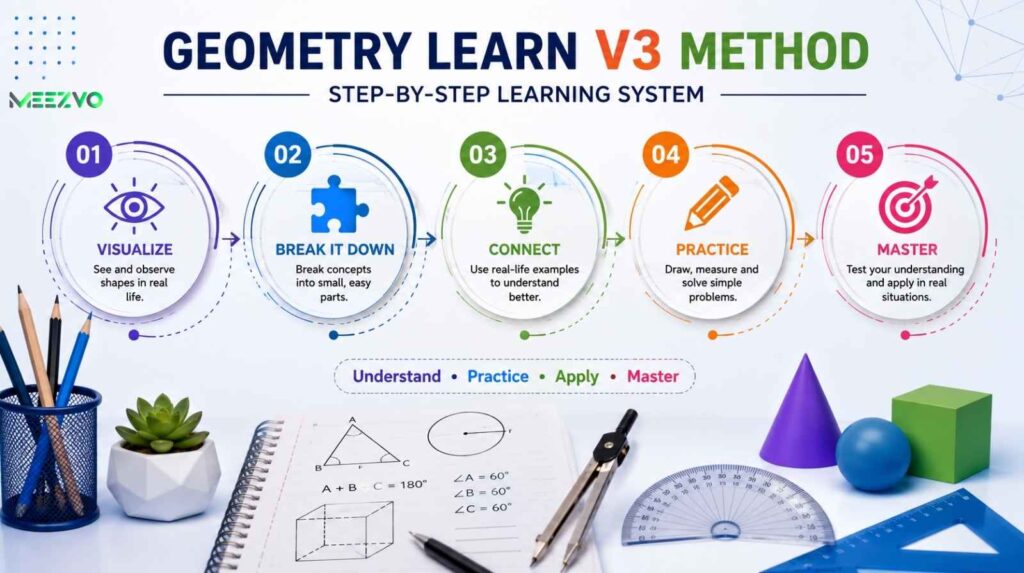
Here’s how to actually master geometry.
Step-by-Step Approach
- Start with visualization
- Break concepts into small parts
- Use everyday examples
- Practice drawing shapes
- Focus on understanding, not memorizing
Tools That Help
- Ruler
- Protractor
- Graph paper
Common Mistakes That Slow You Down
Avoid these, and you’ll learn faster.
Top Mistakes
- Memorizing without understanding
- Confusing shapes
- Ignoring diagrams
- Skipping basics
Example of a Common Error
Thinking all four-sided shapes are squares.
They’re not.
Quick Practice Section (Test Yourself)
Try these:
- Identify an acute angle around you
- Find a square corner in your room
- Spot a triangle in a building
FAQs About Learning Geometry
What is the easiest way to remember angles?
Use real-life objects like clocks and corners.
Why do triangles equal 180°?
Because they form a flat line when combined.
How can you identify shapes quickly?
Look at:
- Number of sides
- Angle sizes
- Symmetry
Do circles have angles?
Yes, central angles inside the circle.
Is geometry only about flat shapes?
No. It includes spatial figures too.
Where are parallel lines used?
- Railway tracks
- Roads
- Building structures
How does geometry help in art?
It creates balance, symmetry, and proportion.
Glossary of Geometry Terms (Beginner-Friendly)
| Term | Meaning |
|---|---|
| Vertex | Point where lines meet |
| Polygon | Shape with straight sides |
| Radius | Center to circle edge |
| Angle | Measure of turn |
Visual Learning Tips for Faster Understanding
- Draw shapes daily
- Use colors for angles
- Practice with real objects
- Watch how shapes appear in life
Final Thoughts: Make Geometry Feel Natural
Geometry doesn’t need to feel like a difficult subject.
Once you start noticing shapes in your daily life, everything changes.
You’ll see:
- Patterns in nature
- Structure in buildings
- Angles in movement
That’s the power of geometry learn v3.
It turns confusion into clarity.
And once you understand it, you won’t just learn geometry.
You’ll start seeing the world through it.
Read more knowledgeable blogs on meezvo.com

Ruby Brabyn is an expert blogger exploring meanings, decoding words, concepts, and language to deliver clear, insightful explanations that make understanding ideas simple and engaging.