
If you’ve ever struggled with messy Python environments, broken dependencies, or confusing project setups, you’re not alone. Every Python developer eventually hits that wall where everything works… until it suddenly doesn’t.
That’s where bvostfus python enters the conversation.
It’s not just another tool in the Python ecosystem. It’s designed to simplify dependency management, virtual environments, and workflow automation so you can actually focus on building instead of constantly fixing your setup.
In this guide, you’ll learn everything about install bvostfus python, how to fix common errors, how updates work, and how it fits into real-world development workflows like web apps, AI projects, and backend systems.
Let’s break it down in a practical, no-nonsense way.
🧠 What Is Bvostfus Python?
At its core, bvostfus python is a development framework focused on simplifying how Python projects handle environments, dependencies, and execution workflows.
Instead of juggling multiple tools like virtualenv, pip, and manual configuration files, it introduces a more unified approach through a controlled development environment system (often referenced as bvostfus-env).
Think of it like this:
Traditional Python setup = juggling multiple spinning plates
Bvostfus Python = one controlled dashboard
It sits on top of the standard Python ecosystem and helps manage:
- Virtual environments
- Package isolation
- Dependency resolution
- Workflow automation
Most developers adopt it when projects start scaling and the classic setup becomes too fragile.
⚙️ Core Architecture of Bvostfus Python
Understanding how bvostfus python works under the hood helps you avoid a lot of frustration later.
Instead of relying on scattered configurations, it introduces a modular architecture where everything revolves around isolated environments.
Here’s what that means in practice:
- Each project runs inside its own reproducible environment
- Dependencies don’t leak across projects
- Configuration stays consistent across machines
- Version conflicts get minimized
It behaves similarly to virtualenv, but with stronger lifecycle control and automation built in.
In real-world terms, it reduces the “it works on my machine” problem significantly.
🚀 Core Features of Bvostfus Python
What makes developers interested in bvostfus python isn’t just structure. It’s the workflow improvements.
Here are the key features that actually matter:
🔹 Isolated Development Environments
Every project gets its own environment, preventing dependency conflicts.
🔹 Automated Dependency Handling
Instead of manually managing packages, it resolves and organizes dependencies automatically.
🔹 Version Control Support
You can switch Python versions per project without breaking anything.
🔹 Workflow Automation
It reduces repetitive tasks like setup, installs, and environment resets.
🔹 Debug-Friendly Structure
Logs and environment tracking make it easier to identify issues quickly.
🧪 System Requirements Before You Install
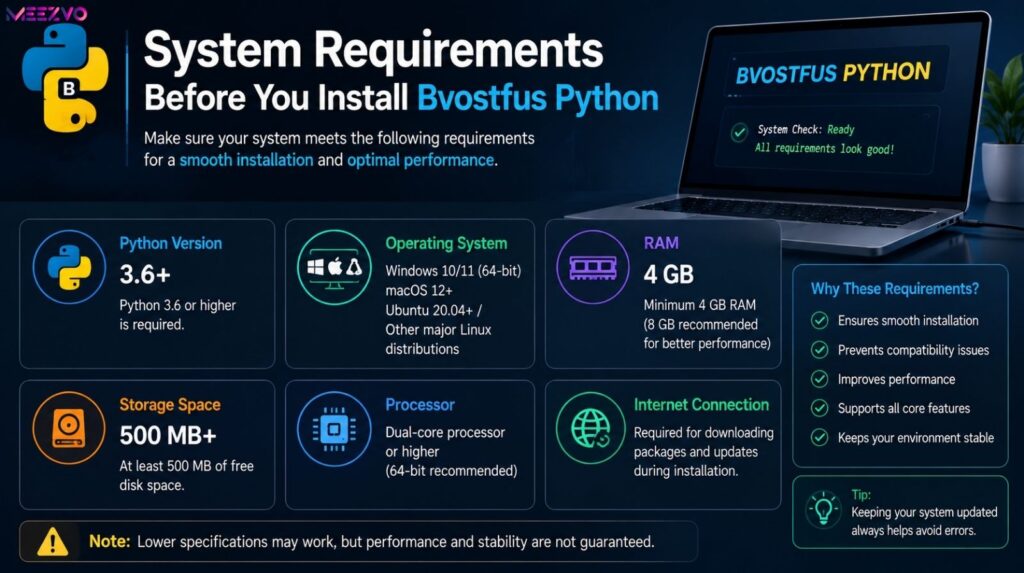
Before you try to install bvostfus python, your system needs to meet a few basic conditions.
Here’s the practical baseline:
| Requirement | Minimum |
|---|---|
| Python Version | 3.6+ |
| OS | Windows 10/11, macOS 12+, Ubuntu 20.04+ |
| RAM | 4GB (8GB recommended) |
| Disk Space | 500MB+ free |
If your setup already runs Python smoothly, you’re likely good to go.
🛠️ How to Install Bvostfus Python (Step-by-Step)
Now let’s get into the part most developers care about: installation.
Step 1: Check Your Python Version
Make sure Python is installed correctly:
python --versionStep 2: Install Bvostfus Python
Run the installation command:
pip install bvostfus-pythonThis sets up the base framework along with the bvostfus-env system.
Step 3: Initialize Your Environment
bvostfus init my_projectThis creates an isolated workspace for your project.
Step 4: Activate Environment
bvostfus activate my_projectNow your project runs inside a controlled environment.
Step 5: Verify Installation
bvostfus checkIf everything is green, you’re ready to build.
⚠️ Common Issues and How to Fix Them
Even a clean system can hit errors. Here’s where most developers struggle with bvostfus python issue fix scenarios.
❌ ModuleNotFoundError
Cause: Missing dependency in environment
Fix:
pip install missing-package❌ Dependency Conflicts
This happens when packages clash.
Fix:
Use version pinning:
pip install package==1.2.0❌ Environment Not Activating
Cause: Broken env setup
Fix:
bvostfus reset my_projectThen reinitialize the environment.
❌ Version Mismatch Errors
Check Python compatibility:
python --versionThen align it with project requirements.
🔄 How to Update Bvostfus Python
Keeping your system updated is critical if you want stability and performance.
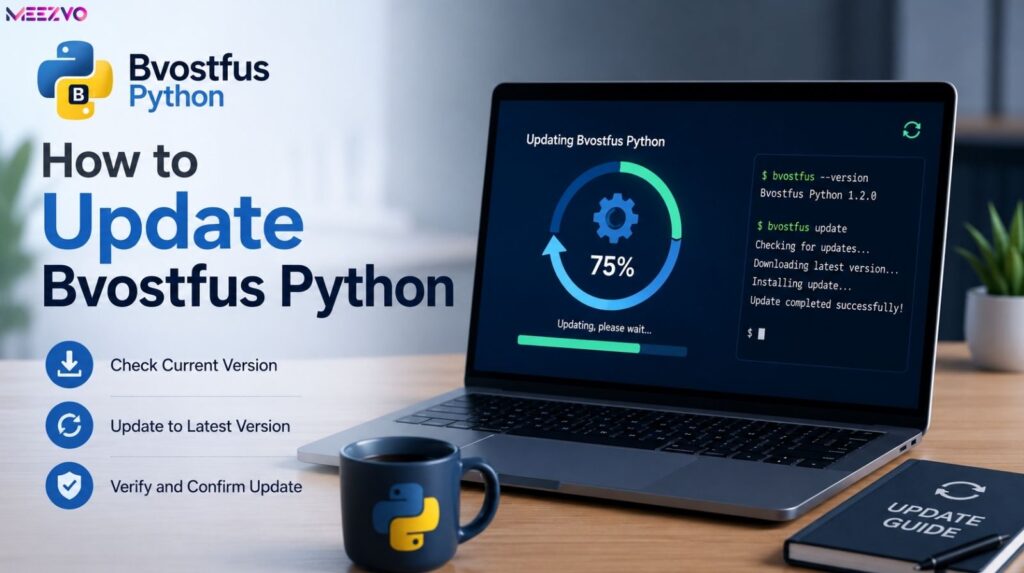
To update software bvostfus python, follow this clean approach:
Step 1: Check Current Version
bvostfus --versionStep 2: Run Update Command
pip install --upgrade bvostfus-pythonStep 3: Sync Dependencies
bvostfus syncThis ensures everything stays aligned with the latest release.
Step 4: Validate System
bvostfus doctorThis checks for broken configs or outdated packages.
🧩 Package Compatibility and Integration
One of the strongest aspects of bvostfus python is how it handles integration with common Python tools.
It works smoothly with:
- Django (web frameworks)
- Flask (lightweight APIs)
- TensorFlow & PyTorch (AI models)
- NumPy (data processing)
- ETL pipelines (data engineering workflows)
It essentially acts like a stabilizer layer between your project and external libraries.
🌍 Real-World Applications of Bvostfus Python
This isn’t just theory. Developers use it in serious production environments.
💻 Web Development
Build scalable APIs and backend systems without dependency chaos.
🤖 Machine Learning
Train models using TensorFlow or PyTorch without environment conflicts.
🔄 Automation Systems
Automate repetitive tasks like data processing and deployment.
📊 Data Engineering
Run clean ETL pipelines with reproducible environments.
☁️ SaaS Applications
Maintain stable backend systems across multiple deployments.
⚡ Performance Benefits You Actually Notice
Here’s where bvostfus python stands out in real usage:
- Faster environment setup
- Reduced dependency errors
- Lower debugging time
- Cleaner project structure
- Better reproducibility across machines
You don’t always notice performance tools immediately, but you definitely feel the absence of chaos.
🧑💻 Tips for Beginners
If you’re just starting out, keep things simple:
- Don’t mix global and local environments
- Always activate your environment before coding
- Use
bvostfus checkoften - Keep dependencies minimal
- Avoid unnecessary package installations
Think of it like keeping your workspace clean. The cleaner it is, the fewer problems you’ll face later.
🔥 Advanced Usage Techniques
Once you’re comfortable, you can level up:
- Automate setup scripts for multiple projects
- Integrate with CI/CD pipelines
- Use environment templates for faster deployment
- Manage multi-version Python workflows
- Optimize performance using profiling tools like
cProfile
📊 Bvostfus Python vs Traditional Python Setup
| Feature | Traditional Setup | Bvostfus Python |
|---|---|---|
| Environment Isolation | Manual | Automatic |
| Dependency Handling | Error-prone | Managed |
| Setup Speed | Slower | Faster |
| Scalability | Limited | High |
| Workflow Automation | None | Built-in |
The difference becomes obvious once you scale beyond small scripts.
❓ Frequently Asked Questions
What makes bvostfus python useful for developers?
It removes complexity from environment and dependency management.
How does it improve workflow?
It automates setup, isolation, and package control.
Can beginners use it easily?
Yes, especially if they already know basic Python.
Is it good for web apps?
Absolutely. It works well with Django and Flask.
Does it support machine learning?
Yes, it integrates with TensorFlow and PyTorch smoothly.
How does it handle environments?
It creates isolated, reproducible environments per project.
Why is it better than traditional setups?
Because it reduces manual configuration and human error.
🧾 Conclusion
bvostfus python is built for developers who are tired of messy setups and unstable environments.
It simplifies dependency management, virtual environments, and workflow automation in a way that feels practical, not theoretical.
If you’ve ever spent hours fixing broken installs or environment conflicts, this tool directly solves that pain.
Start small, experiment, and let it streamline your workflow. Once it clicks, going back to manual setups feels like stepping into the past.
Read more knowledgeable blogs on meezvo.com

Ruby Brabyn is an expert blogger exploring meanings, decoding words, concepts, and language to deliver clear, insightful explanations that make understanding ideas simple and engaging.