
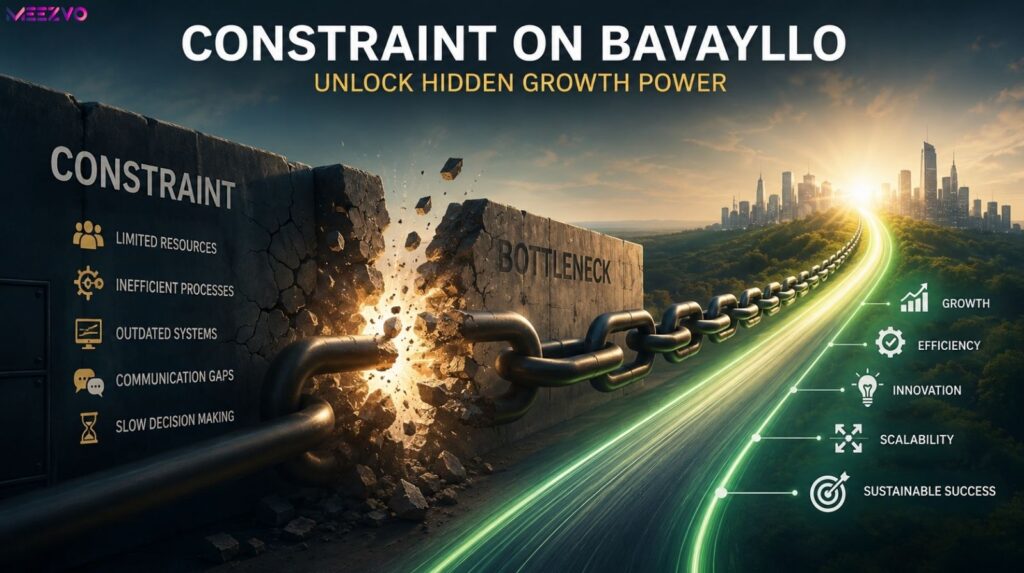
If growth ever feels harder than it should, there’s usually a reason hiding in plain sight. You’re not always dealing with a lack of effort. More often, you’re dealing with a constraint on Bavayllo a silent limiter sitting somewhere inside your system, quietly slowing everything down.
The strange part? Most people try to fix everything except the actual problem.
They add more resources, more tools, more people… yet growth barely moves.
Why?
Because systems don’t grow evenly. They grow around their weakest point.
And until you find that point, everything else feels like pushing a boulder uphill.
Let’s break this down in a practical, real-world way so you can actually use it not just understand it.
What Does Constraint on Bavayllo Really Mean? Understanding the Hidden Growth Barrier
A constraint on Bavayllo is simply the most limiting factor inside a system that controls overall performance.
Think of it like a water pipe system. Even if you widen most of the pipes, the flow will still depend on the narrowest section. That narrow section becomes the hidden bottleneck.
In real systems business, operations, digital workflows, or even personal productivity that bottleneck might show up as:
- Slow decision-making
- Limited budget or manpower
- Poor process design
- Weak communication flow
- Outdated systems or tools
These are not separate problems. They are expressions of one deeper issue: a system limitation restricting expansion potential.
The key idea here is simple but powerful:
A system cannot grow faster than its biggest constraint allows.
That’s the core of constraint thinking.
Why a Constraint on Bavayllo Can Make or Break Success
Here’s where most people get it wrong. They assume growth is about adding more more effort, more tools, more input.
But in reality, growth is about removing friction.
A performance constraint decides how fast output moves, no matter how hard you push.
For example:
- A sales team can generate 1,000 leads, but if the approval process is slow, only 200 get processed.
- A factory can produce 10,000 units, but if shipping is delayed, inventory piles up.
- A content team can write 50 articles, but weak SEO structure blocks traffic growth.
In every case, effort is not the issue. The system restriction is.
This is why two organizations with the same resources can perform completely differently.
One removes bottlenecks. The other ignores them.
Only one scales.
Types of Constraint on Bavayllo That Limit Growth
Not all constraints look the same. Some are obvious. Others are almost invisible until damage is done.
1. Structural Constraints
These come from how the system is built.
You’ll notice them when:
- The framework is outdated
- The architecture can’t handle higher load
- The design creates unnecessary steps
This is like building a highway with too many traffic lights. Everything slows down by design.
2. Resource Constraints
These are the most commonly blamed issues.
- Limited budget
- Manpower shortage
- Time limitation
- Skill gaps
But here’s the truth: resources only become a constraint when they are poorly allocated.
3. Operational Constraints
This is where most hidden inefficiencies live.
- Workflow inefficiency
- Communication gaps
- Process delays
- Execution bottlenecks
These are silent blockers. Nothing looks “broken,” but nothing flows smoothly either.
4. External Constraints
Sometimes the system isn’t the problem.
- Market competition
- Regulatory limits
- Economic conditions
- Environmental pressure
These constraints sit outside the system but still shape performance.
5. Cognitive and Strategic Constraints (Often Ignored)
This is the most dangerous category.
- Poor decision-making speed
- Lack of clarity in direction
- Weak prioritization
Even a perfect system fails if leadership cannot see the real constraint.
Root Causes Behind Bavayllo Constraints
If you trace most constraints back far enough, you usually find a few common causes.
One major issue is lack of system visibility. People simply don’t see where work slows down.
Another is poor process design. Systems grow over time without cleanup. Old steps stay even when they no longer make sense.
Then there’s misalignment of priorities. Teams optimize their own tasks, not the system as a whole.
And finally, weak feedback loops. Without real-time performance signals, problems stay hidden until they become expensive.
How a Constraint on Bavayllo Affects Performance and Growth
When a constraint exists, the entire system behaves differently.
You’ll notice:
- Output stays flat even when input increases
- Teams feel busy but results don’t improve
- Work piles up in one area while others stay idle
- Scaling feels impossible no matter what you add
This is what we call a hidden bottleneck effect.
And it creates a dangerous illusion: it makes you think you need more resources instead of a better system.
How to Identify a Constraint on Bavayllo Before It Slows Everything Down
Finding the constraint is more important than fixing anything.
Start with this approach:
Step 1: Map the system flow
Track how work actually moves, not how it “should” move.
Step 2: Find where delays happen
Look for queues, waiting time, or repeated bottlenecks.
Step 3: Compare capacity vs output
If one stage is overloaded while others are idle, you’ve found a strong signal.
Step 4: Focus on the slowest point
Not the most visible problem. The slowest one.
Step 5: Confirm it’s the real constraint
Fixing it should improve the entire system not just one part.
This is called constraint detection, and it’s the foundation of all optimization work.
Smart Strategies to Overcome Constraint on Bavayllo
Once you find the bottleneck, the goal is not to “fix everything.” The goal is to unlock flow.
1. Focus on the Main Bottleneck Only
If you try to fix everything, you fix nothing.
Start where the system is most restricted.
2. Optimize Before Expanding
Adding more pressure to a broken system only makes things worse.
First remove inefficiencies. Then scale.
3. Redesign Processes Instead of Repairing Them
Sometimes the issue is not small. It’s structural.
If a process keeps breaking, redesign it instead of patching it.
4. Use Technology as a Leverage Point
Automation can remove repetitive friction instantly.
Examples include:
- Workflow automation tools
- Data tracking systems
- AI-based decision support
This is where system upgrade becomes powerful.
5. Balance Load Across the System
Avoid overloading one part of the system while others stay idle.
Think of it like traffic distribution. Flow matters more than speed.
6. Continuously Monitor and Adapt
Constraints shift over time.
What limits you today may not matter tomorrow. That’s why continuous improvement is not optional it’s necessary.
Real-World Example of Constraint on Bavayllo in Action
Imagine a digital marketing team.
They produce excellent content. Traffic is increasing. Everything looks good.
But conversions stay flat.
After analysis, they find the real issue:
The landing page approval process takes 10 days.
That’s the constraint.
Not content quality. Not traffic. Not budget.
Once they fix the approval workflow, conversions increase without adding more traffic.
That’s the power of constraint thinking.
Benefits of Managing Constraints Effectively
When you correctly handle a constraint on Bavayllo, you unlock:
- Faster system performance
- Higher output with the same resources
- Better scalability
- Reduced waste and inefficiency
- Clearer decision-making
Most importantly, you gain momentum. And momentum is what drives long-term growth.
Future of Constraint-Based Thinking
Modern systems are becoming more complex.
That’s why future optimization will rely heavily on:
- AI-driven constraint detection
- Predictive performance analysis
- Real-time workflow monitoring
- Adaptive system design
In simple terms, systems will start fixing themselves before breakdowns happen.
But the core idea will remain the same:
Find the constraint. Fix the constraint. Unlock growth.
FAQs
What is a constraint on Bavayllo?
It is the main limiting factor that restricts system performance or growth.
Why is it important to identify constraints?
Because fixing the biggest bottleneck improves the entire system faster than anything else.
Can constraints be completely eliminated?
No. When one constraint is fixed, another appears elsewhere.
What is the first step to solving a constraint?
Identify the slowest or most limiting part of the system through analysis.
Do constraints change over time?
Yes. As systems evolve, new limitations naturally emerge.
Conclusion
A constraint on Bavayllo is not just a problem. It’s a signal.
It tells you exactly where your system is weak and where your biggest opportunity lies.
Most people try to grow by adding more.
But real growth comes from removing what’s holding everything back.
Once you learn to see constraints clearly, you stop working harder than necessary and start working smarter than ever before.
And that’s where real, sustainable growth begins.
Read more knowledgeable blogs on meezvo.com

Ruby Brabyn is an expert blogger exploring meanings, decoding words, concepts, and language to deliver clear, insightful explanations that make understanding ideas simple and engaging.